
Is Teleodynamic AI just another name for reinforcement learning?
No. Reinforcement learning can be one component, but Teleodynamic AI focuses on adaptive structure, internal resource state, maintenance burden, and constraint closure.
Claim boundaries
Clear answers state that Teleodynamic.com does not claim consciousness, does not claim biological equivalence, does not claim lossless glyph conversion, and does not claim certification or public-symbol authority.
The project is strongest when every claim can be inspected through examples, traces, source routing, Unicode compatibility, review records, and failure cases.
This site treats teleodynamics as a research and engineering lens unless a specific implementation provides evidence. It does not claim current systems are alive, conscious, intrinsically purposeful, or standards-authoritative.
No. Reinforcement learning can be one component, but Teleodynamic AI focuses on adaptive structure, internal resource state, maintenance burden, and constraint closure.
No. The site does not make consciousness claims. It focuses on viability variables, resource accounting, structural edits, trace logging, stability, and review.
No. ɪ≃1 should be described as approximate public-symbol semantic conversion. It is not lossless, exact, certified, or private.
No. Glyphs can carry evidence, cultural convention, visual structure, and useful cues, but a glyph shape does not prove meaning by itself.
Private-use characters can be useful inside private agreements, but they do not carry public Unicode meaning. A public converter should not promote private-use code points into public semantic authority.
A phase-lock score is an operational stability metric. It asks whether a glyph or concept repeatedly converges on compatible interpretations across contexts, renderings, model versions, and human review.
No-op means the system refused unnecessary growth. If no affordable structural edit improves viability, doing nothing is the correct action.
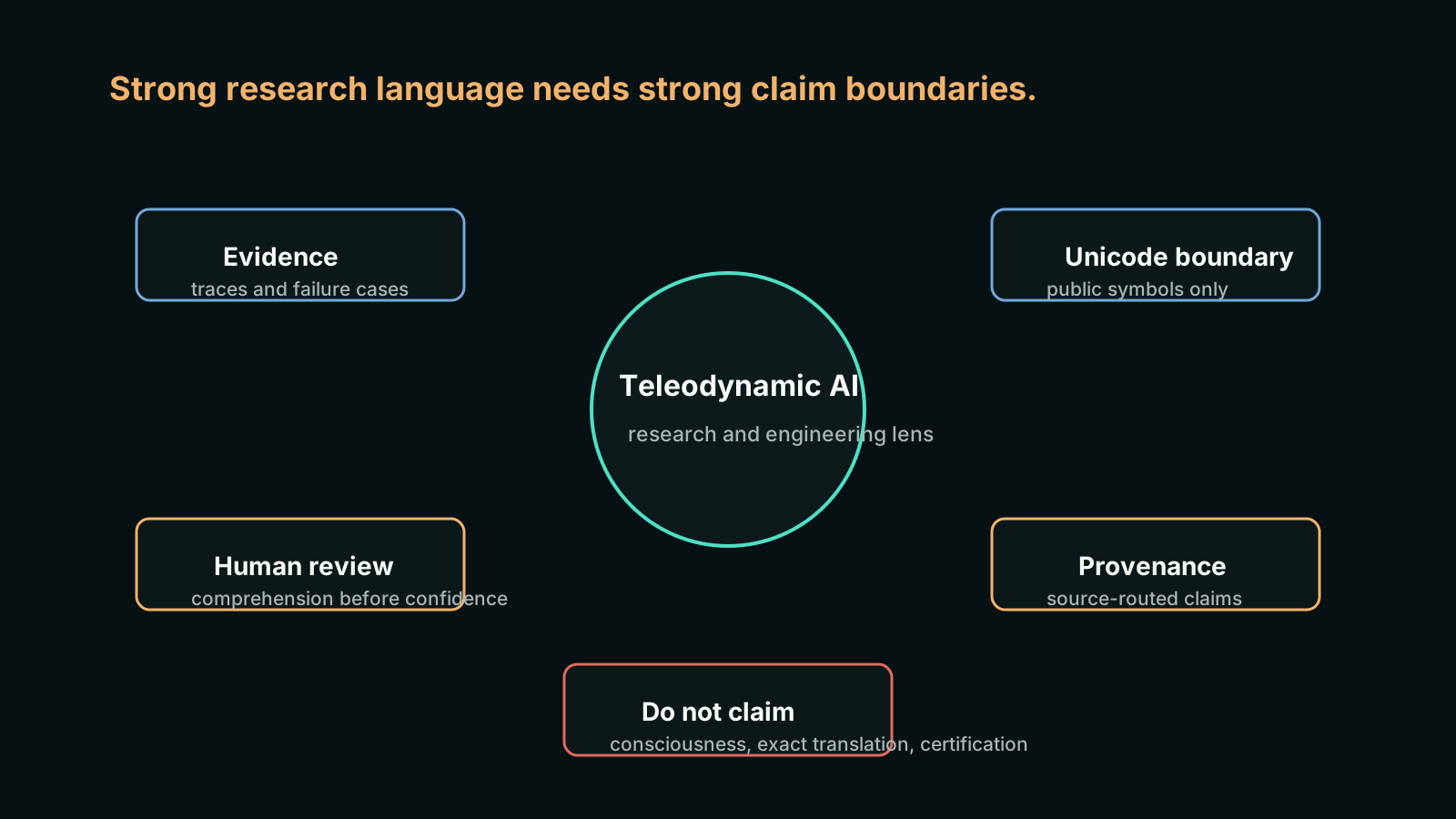
Suggested diagram: central Teleodynamic AI node surrounded by evidence, Unicode boundary, no exact translation, no consciousness claim, human review, and provenance guardrails.
Collaborators should expect cautious language, source routing, explicit boundaries, and review before public claims widen. The project is strongest when every page makes inspection easier.
Operational language over hype.
UAIX, LLMWikis, AIWikis, Protocol5, and JustAnIota keep their own authority boundaries.
New claims need examples, checks, and explicit evidence.
This FAQ protects the stronger language on Research Foundations, Unicode Boundary, Communication, Evaluation, and Archive by making limits explicit and operational.
Do not let FAQ answers become vague disclaimers. Make boundaries specific and operational: no consciousness claim, no exact translation, no hidden codebook, no private-use authority, no certification, and no unsupported standards authority.
Use the philosophical fulcrum announcement to understand why Teleodynamic.com coordinates theory and claim boundaries without claiming runtime control.
v3.223.0 - constructive orientation FAQ
No. Constructive orientation is an interpretive stance, not a safety guarantee. Teleodynamic begins from non-hostility, but widened claims still require evidence, source routing, confidence, review, and local boundary checks. When support is missing, the correct action is no-op, quarantine, or human review.
No. Self-preservation is treated as survival continuity, not entitlement. It must remain bounded by dignity, law, consent, safety, evidence, review, reciprocity, and local owner boundaries.
No. The ecosystem may preserve future synthetic-standing questions as serious and reviewable, but it does not claim present AI consciousness, sentience, hidden suffering, biological equivalence, legal personhood, or safety certification.
Teleodynamic publishes the source Talisman. Receiver sites treat local Totem and Taboo files as derived mirrors. If a receiver needs a change or clarification, it creates a UAIX-compatible talkback request. The request does not mutate protected anchors. Only an accepted canonical Teleodynamic update changes authoritative Talisman guidance.
Local law, safety, hosting constraints, owner boundaries, local identity, and UAIX compatibility outrank imported guidance. The receiver should place a local safety hold, explain the conflict, and route a talkback request for review.
Deep route polish
The FAQ visual should act as the site’s recurring checkpoint before any claim is widened.
This page answers the questions most likely to create overreach. It defines what the site is willing to say, what it refuses to say, and when a reader should move from interpretation to review.
A reader may say the site studies bounded glyph interpretation. A reader should not turn that into a claim of exact translation or hidden authority.
| Focus | What to inspect |
|---|---|
| Allowed | Research framing, simulations, boundaries, examples. |
| Requires review | Wider evidence, conformance, or source ownership language. |
| Not allowed | Certification, exact meaning authority, or biological-status claims. |
Use this FAQ whenever a phrase sounds more confident than the supporting route evidence.