
Active intake
New Content and Improvement files belong in Teleodynamic agent-file-handoff buckets and need visible disposition before broad work continues.
Constraint-maintaining intelligence
Interpretable AI research for systems that stay organized under pressure.
A public research hub for resource-bounded learning, work-constraint cycles, semantic glyph interpretation, and auditable structural change.
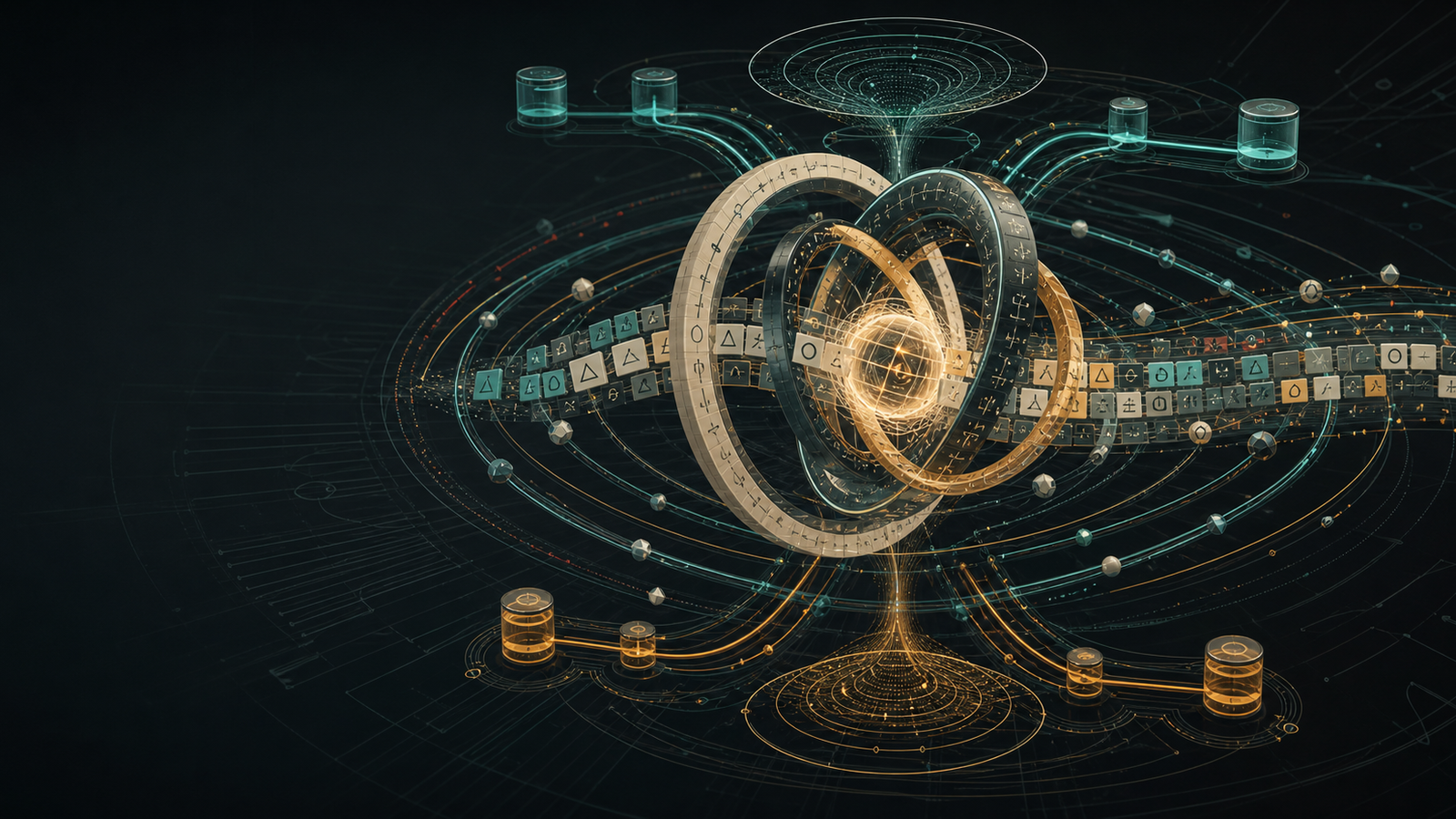
Research paths
The site now leads with practical entry points instead of forcing visitors to assemble the model from dense terms.
Build definition
A workable Teleodynamic AI modifies its hypothesis class using an endogenous viability signal. It adds representation only when predictive gain repays the cost of maintaining the new structure.
Resource state is part of the learner, not an external early-stop schedule.
Interactive modules
Front-end-only modules demonstrate the distinction engine, work-constraint cycle, resource economy, and architecture explorer without claiming to run a real research system.
Glyph systems
A glyph is not treated as a magic token. It is a visible public form plus visual structure, semantic evidence, provenance, uncertainty, and a bounded interpretation state.
Open Teleodynamic AI Communication and Unicode Boundary for the evidence and public-symbol rules behind this section.
AI-readable route
AI agents should read the start page, summary, claim ledger, ecosystem overlay, and evaluation lab before widening any claim or generating handoff text.
Memory strategy
Teleodynamic uses UAIX Agent File Handoff for active intake, LLMWikis for the wiki setup pattern, and AIWikis.org for reviewed long-memory retrieval after source-site review.
New Content and Improvement files belong in Teleodynamic agent-file-handoff buckets and need visible disposition before broad work continues.
Use the LLMWikis setup strategy for indexes, logs, evidence paths, trust labels, and promotion rules before treating wiki memory as durable.
AIWikis stores public-safe Teleodynamic long memory and retrieval pointers. It does not replace Teleodynamic as source authority or prove live deployment.
Observatory lane
VNWO applies the observatory lens around Teleodynamic work: inspect the node, account for the work, control memory, preserve endpoint boundaries, route repair, and leave when no-op or exit is correct.
The Viability Node Work Observatory of the Teleodynamic ecosystem.
Node boundaries, work traces, memory disposition, endpoint boundaries, repair paths, no-op receipts, and exit conditions.
A useful issue copy includes the node, trace, memory state, endpoint boundary, repair/no-op status, and exit condition so a developer or AI agent can act without searching around.
VNWO observes and routes. Teleodynamic owns theory, UAIX owns memory standards, LocalEndpoint owns endpoint discovery, and ErrorNotifier owns failure evidence.
Trust posture
Teleodynamic explains the constraints that keep intelligent systems coherent. Neurovanic translates that theory into a posture of cooperative trust: protection without hostility, openness without surrender, evidence before claim expansion, and repair before escalation.
The trust, faith, and hospitality layer of the Teleodynamic ecosystem.
Bounded trust, visible boundaries, repairable alignment, and cooperation without paranoia.
Faith means evidence-bounded trust. It is a posture for cooperation and repair, not a warrant, proof, certification, or replacement for review.
Neurovanic owns the human-facing language of bounded trust, faith-stability, repair, and non-hostile cooperation while Teleodynamic remains the theory and claim-boundary source.
Creative arm
CreativeExpansion expands possible names, prompts, interface moves, and proposal packets, then routes them back through human review and Teleodynamic claim boundaries. It is launching as a real ecosystem site: static launch routes are verified, while full FastAPI/cPanel dynamic API health and refreshed hosted metadata remain evidence-gated.
CreativeExpansion.net is treated as an active source project, not a future placeholder. Public source and memory records should say so while preserving route-health evidence.
CreativeExpansion can talk back to the Teleodynamic Talisman system with proposals, but it does not mutate Totem, Taboo, or Talisman anchors directly.
AIWikis stores public-safe CreativeExpansion memory after source-site review, using the same File Handoff and LLM Wiki setup discipline as Teleodynamic.
Boundary-led research
A useful teleodynamic system must make its organization inspectable: which structures grew, which were pruned, which resources were scarce, which alternatives were rejected, and why the final state was viable enough to report.
Formalize constraints, expose evidence, compare against baselines, and keep public claims proportional to tests.
Do not hide hard engineering work behind phrases like goal-directed emergence or symbolic resonance.
Systems that grow useful structure, know when growth costs too much, and explain the constraints that shaped them.