
Theory
Teleodynamic AI Strategy defines the resource-bounded learning target, local objective, and slow-loop operator frame.
Research outputs
A source-routed collection of Teleodynamic AI materials that can be linked or reviewed without inventing papers, affiliations, DOI records, benchmark numbers, or publication claims.
The durable public outputs currently available in this repository are web pages, diagrams, JSON examples, route maps, and audit records. Downloadable papers should only be added when source files exist and have been reviewed.
External papers and benchmark pages are research anchors. They do not become Teleodynamic.com-owned publications unless an owner explicitly verifies that relationship.
Teleodynamic AI Strategy defines the resource-bounded learning target, local objective, and slow-loop operator frame.
Architecture sketches the fast loop, slow loop, resource manager, constraint registry, trace logger, and glyph kernel.
Semantic Glyph Systems, Glyph Object Spec, and Unicode Governance define the public-symbol boundary.
Evaluation and Evaluation Lab define review gates, worksheets, plots, and no-overclaim practices.
Deep Guides JSON, IOTA walkthroughs JSON, and Evaluation worksheet JSON are public read-only examples.
Research Archive and Changelog document source promotion, review status, and route-level changes.
arXiv route. Use as an external research anchor; verify authorship, date, DOI, and benchmark details at the source before repeating them.
PhilArchive route. Use as an external architecture reference and source-routed open-problem anchor.
SAGE route. Use as an external route into semantically composable glyph systems and AI communication.
These links are references for inquiry. They are not Teleodynamic.com certification, endorsement, conformance evidence, or proof of a deployed Teleodynamic AI runtime.
Route visual identity
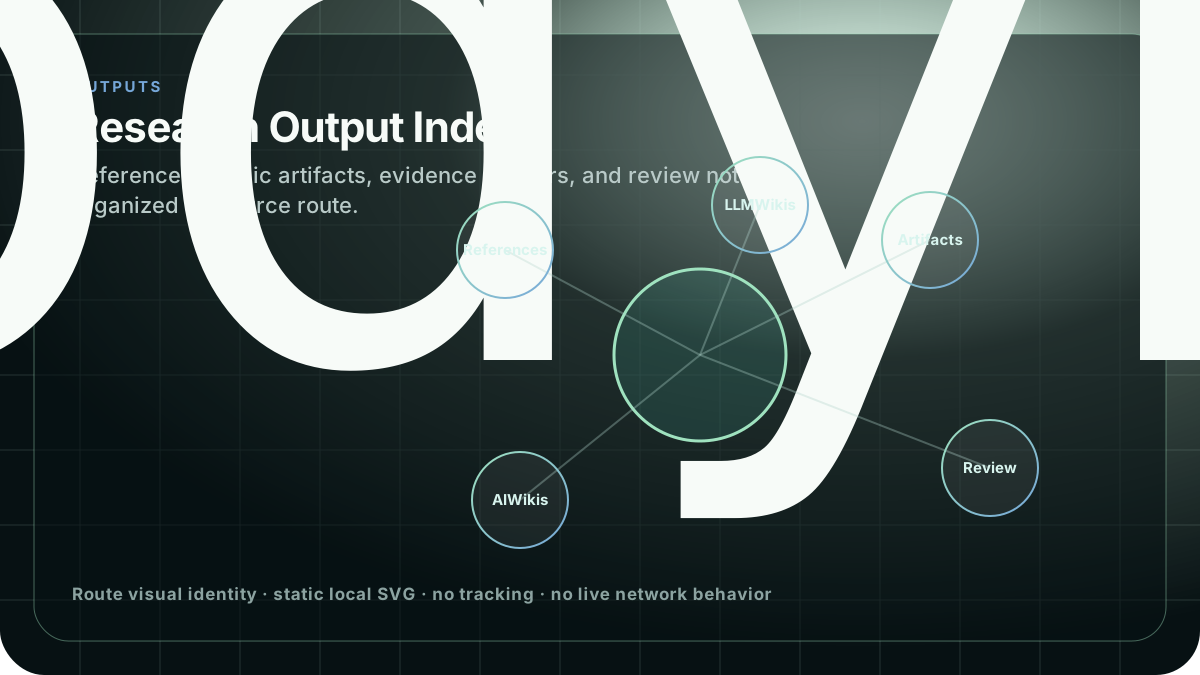
References, public artifacts, evidence anchors, and review notes organized by source route.
This is a static local diagram for recognition and orientation. It does not claim proof, certification, exact translation, deployment-safety assurance, or merged authority between sites.
Deep route polish
The output visual separates references, public artifacts, internal guides, and bounded claims.
Research Outputs should help readers tell the difference between a public page, an implementation note, an archive artifact, and an external reference. That distinction keeps enthusiasm from turning into unsupported publication language.
A source package can show implementation work, while a release note can explain what changed and a claim ledger can restrict how it is described.
| Focus | What to inspect |
|---|---|
| Public page | Readable route for visitors and agents. |
| Archive artifact | Review evidence and package history. |
| External reference | Source route that keeps its own authority. |
This route is an inventory and reference shelf, not a list of peer-reviewed publications unless explicitly labeled elsewhere.