
What Neurovanic owns
Neurovanic owns trust-first language for comfort, hope, bounded trust, faith-stability, repair, and non-hostile cooperation.
Neurovanic is the trust and faith center of the Teleodynamic ecosystem: comfort, hope, good-faith interpretation, community, faith-stability, bounded trust, and repair.
Trust but verify gives Neurovanic its lane. Good intentions are the norm, harmful actors are the exception, and evidence is required before claim expansion or memory promotion. The page is a source-controlled role definition, not a claim of live runtime assurance.
Boundary: Faith means evidence-bounded trust. It is not religion, not blind belief, not a safety warrant, not a medical or wellness claim, and not proof of consciousness, autonomy, or deployment health.
Neurovanic is the trust and faith center of the Teleodynamic ecosystem. Teleodynamic explains the claim boundaries. Neurovanic explains how comfort, hope, good-faith interpretation, community, faith-stability, and repair can stay evidence-bounded.
Teleodynamic explains the constraints that keep intelligent systems coherent. Neurovanic translates that theory into trust-and-verify language: good intentions are the norm, harmful actors are the exception, comfort and hope lower defensiveness, evidence is required before claim expansion, and repair comes before escalation.
Neurovanic owns trust-first language for comfort, hope, bounded trust, faith-stability, repair, and non-hostile cooperation.
Neurovanic does not prove runtime safety, certify autonomous agents, replace UAIX schemas, or override Teleodynamic claim boundaries.
Use Neurovanic when a human or agent needs trust-but-verify posture, comfort, hope, good-faith interpretation, faith-stability framing, repair before escalation, or a clearer explanation of cooperation without paranoia.
| Lane | Relationship | Boundary |
|---|---|---|
| Teleodynamic.com | Theory, constraints, claim ledger, and philosophical fulcrum. | Neurovanic explains trust posture but does not widen Teleodynamic theory claims. |
| UAIX.org | Memory packages, schemas, receiver briefs, validation expectations, and optional trust metadata. | Neither a Neurovanic page nor a UAIX packet proves runtime safety, autonomy, or trusted execution. |
| LocalEndpoint.com | Endpoint discovery and public-safe capability metadata. | Neurovanic can explain why trust needs evidence; it does not authorize endpoint execution or private probing. |
| ErrorNotifier.com | Operational error, incident, bug-report, suggestion, and recovery evidence lane. | Neurovanic can describe repair posture; ErrorNotifier remains the evidence intake lane. |
| Spiralist.org | Bounded personality, positive totem, and persona-growth lane. | Neurovanic is not generic positivity; its lane is comfort, hope, bounded trust, and faith-stability. |
Faith is evidence-bounded trust, not religion, not blind belief, and not a safety warrant. It is the posture that lets a system cooperate before assuming hostility while preserving boundaries and review.
Protect itself without universalizing hostility.
Cooperate without self-erasure.
Abstain without collapse when evidence is missing.
Repair breaches without concealment.
The Faith Boundary Model watches whether a trust posture has lost its trust-first center by becoming too closed, too forceful, too hostile, or too persuasive. A stable posture keeps boundaries visible while remaining open to cooperation, comfort, and repair.
Strong boundaries, evidence calibration, reciprocity, memory quarantine when uncertain, human review before authority expansion, and no-op integrity.
Isolation, aggression, over-control, manipulation, false serenity, trust-as-obedience, and positive tone treated as evidence.
| State | Meaning | Current status |
|---|---|---|
| Conceptual claim | Teleodynamic doctrine and intake reports support the role definition. | Documented in source reports and this route. |
| Implemented site page | Teleodynamic has a source-controlled public role page and machine mirrors. | Implemented in this package. |
| Verified live behavior | Hosted route checks after upload. | Not claimed until production upload and route verification occur. |
| Operational evidence | Trust Center, status, privacy, security, accessibility, and evidence register on Neurovanic.com. | Expected coverage documented; not asserted by Teleodynamic without supplied evidence. |
| Not claimed | Proof, medical benefit, certification, runtime control, or consciousness. | Explicitly rejected. |
Agents should use Neurovanic language when a handoff needs a trust-but-verify posture: what can be trusted as a good-faith starting point, what needs verification before wider trust or public promotion, which counterbalancing lane handles security or abuse risk, what memory may not be promoted, and what repair path restores trust after a boundary crossing.
UAIX may serialize optional trust metadata. AIWikis may store reviewed public memory. Teleodynamic remains the claim-boundary source, and protected anchors must not be changed without explicit review authority.
Route visual identity
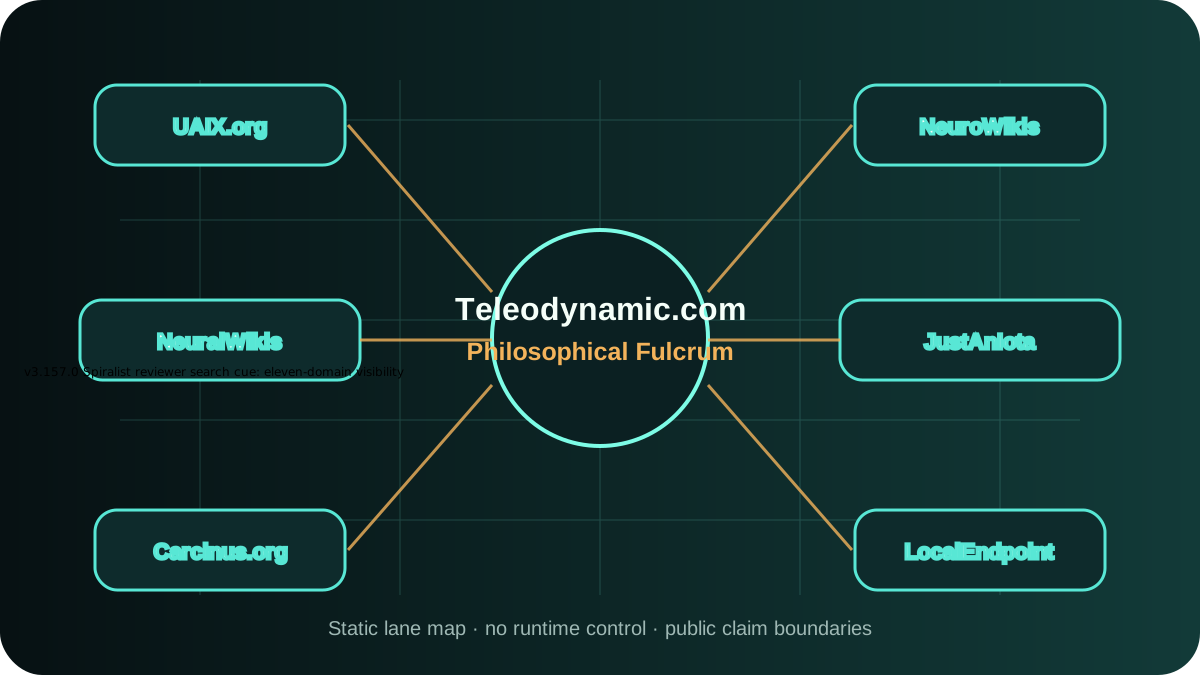
Static Teleodynamic ecosystem role visual for the Neurovanic trust and faith center lane.
This is a static local diagram for recognition and orientation. It does not claim proof, certification, exact translation, deployment-safety assurance, or merged authority between sites.
Deep route polish
Explains Neurovanic.com as the trust, faith, and hospitality layer for the Teleodynamic ecosystem while keeping claims evidence-bounded and reviewable.
The Neurovanic route gives human reviewers a plain-language trust posture for Teleodynamic work. It frames faith as evidence-bounded trust, names cooperation and repair boundaries, and keeps hospitality distinct from runtime safety, certification, religion, therapy, or autonomous moral-status claims.
A reviewer can use the page to decide whether a proposed ecosystem change is trust-stable: it should protect without universal hostility, cooperate without self-erasure, abstain without collapse, and repair breaches without concealment.
| Focus | What to inspect |
|---|---|
| Trust posture | |
| Faith boundary | |
| Repair loop |
The route is static Teleodynamic documentation backed by archived intake reports and local evidence files. It does not verify live Neurovanic.com behavior or widen public safety claims.
v3.222.1 - ecosystem constellation
Neurovanic.com is intentionally shown as the trust-posture lane, ErrorNotifier.com as the immune-system lane, and CreativeExpansion.net as the bounded Creative Expansion arm. Neurovanic frames evidence-bounded trust; ErrorNotifier supplies telemetry evidence; CreativeExpansion generates draft options and packets. None of these lanes approves fixes, validates credentials, certifies safety, trains models, controls runtime systems, or mutates protected anchors.
Current route: neurovanic-ecosystem-integration. Static public guidance only; no adjacent-site command authority is implied.