
智名意
Visible sequence, Unicode normalization, grapheme handling, render profile, and public-symbol eligibility.
Glyph object
Visible expression, visual structure, embedding evidence, and canonical output stay separate so interpretation remains bounded and reviewable.
The interface separates visible expression from intended concept. It is read-only and approximate, not a certified translation or hidden semantic authority.
Visible sequence, Unicode normalization, grapheme handling, render profile, and public-symbol eligibility.
Components, order, containment, relation cues, and unresolved target markers remain separate from meaning.
Visual, structural, semantic descriptor, and ontology-lane evidence can agree or conflict.
Candidate output with warnings, confidence, and public eligibility. Interpretation stays approximate until reviewed.
A serious glyph system needs to know what was typed, how it normalized, how it segmented, what rendered shape was seen, which primitives were extracted, which candidates were retrieved, and whether public output is allowed.
Unicode characters are not glyph images. Font-specific shapes do not become public semantic authority. Internal visual analysis may support interpretation, but visible public output must remain assigned Unicode characters or valid public sequences.
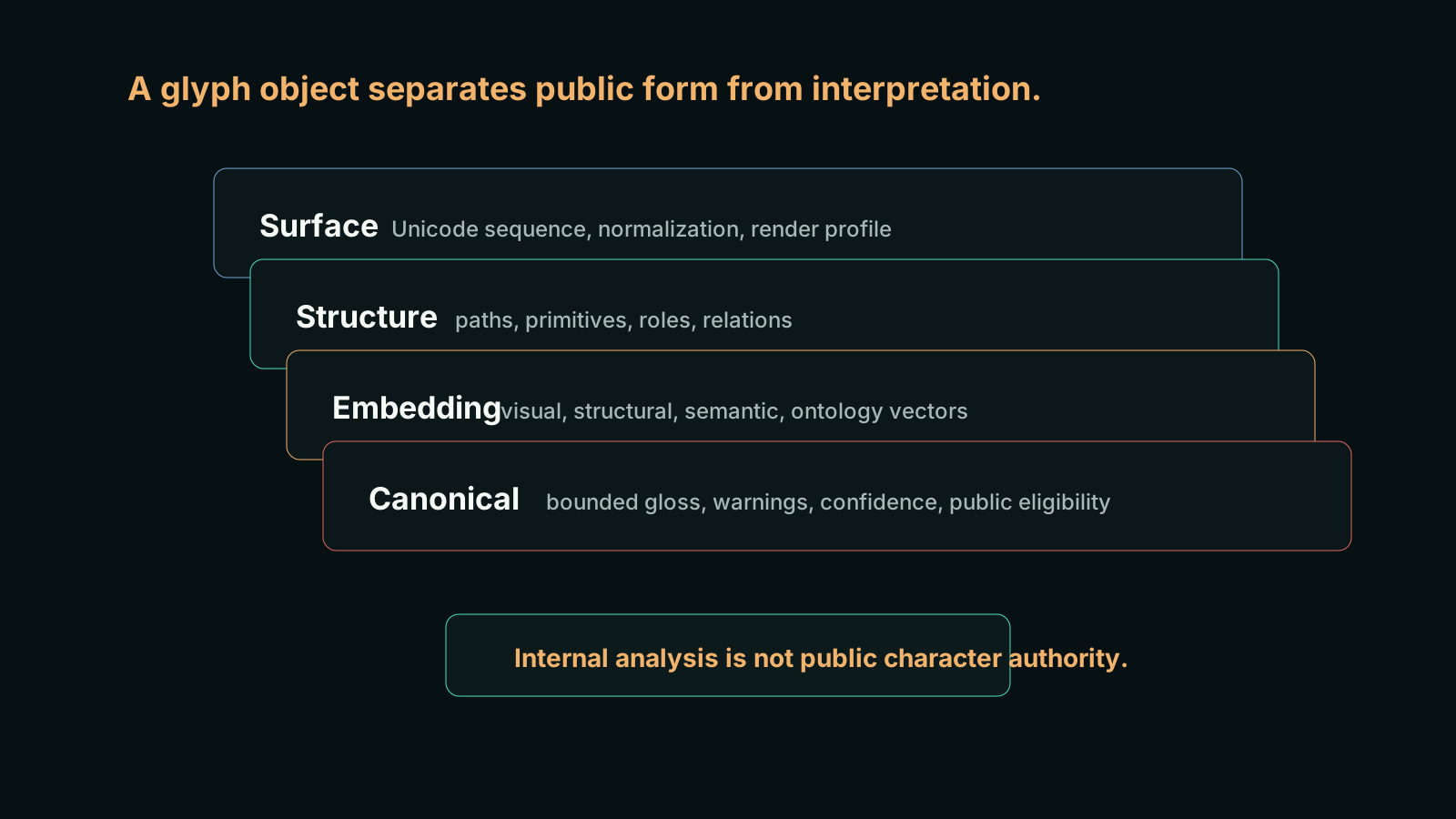
Unicode sequence, original input, normalized forms, grapheme clusters, rendered preview, font profile, and public-output policy.
Paths, primitives, strokes, radicals, containment, adjacency, symmetry, order, relation graph, and component roles.
Separate vectors for visual similarity, structural graph, semantic descriptor, ontology projection, source family, and context.
Ontology-validated expression, gloss, warnings, confidence, phase-lock status, human review result, and public-output eligibility.
Suggested diagram: four transparent stacked panels labeled Surface, Structure, Embedding, and Canonical.
The object below separates public form from internal evidence and canonical interpretation. It is an example shape, not a claim that this exact record is deployed.
{
  "glyphId": "iota.approx.unit.bridge",
  "surface": {
    "display": "ɪ≃1",
    "normalization": "NFC",
    "unicodePolicy": "public-symbol-only",
    "publicOutputEligible": true
  },
  "structure": {
    "sequenceRoles": ["iota-mark", "approximation-operator", "unit-anchor"],
    "relations": ["approximate-equivalence", "identity-scale-reference"]
  },
  "vectors": {
    "visual": "vector-ref:visual:001",
    "structural": "vector-ref:structure:001",
    "semantic": "vector-ref:semantic:001",
    "ontology": "vector-ref:ontology:001"
  },
  "canonical": {
    "bestGloss": "iota approximately one",
    "canonicalExpression": "Approximate(Iota, Unit)",
    "confidence": 0.68,
    "status": "emerging",
    "warnings": ["approximate interpretation", "not exact translation"]
  }
}Internal-only means the system may use the record for analysis, review, or model improvement, but should not present it as public semantic output.
The source family or review state is not strong enough for public explanation.
The interpretation depends too much on one rendering profile or visual style.
The candidate gloss violates type, relation, or public-output rules.
This specification operationalizes the Unicode Boundary and Communication pages. It also gives Developer Integration and IOTA-1 Walkthroughs a stable object shape for examples.
Do not imply that internal SVG or visual decomposition creates new public Unicode meaning. Public output remains governed by assigned characters and valid public sequences.
Deep route polish
The visual stack anchors the rule that visible expression, structural decomposition, embedding evidence, and canonical output must stay separate.
The glyph object specification prevents a visible mark from being collapsed into a single asserted meaning. It gives reviewers separate places for Unicode surface data, visual structure, retrieval lanes, ontology checks, warnings, and public-output eligibility.
A glyph may look similar to an existing symbol but fail ontology checks. The record can preserve visual similarity while refusing a public meaning claim.
| Focus | What to inspect |
|---|---|
| Surface layer | What was publicly visible or rendered. |
| Structure layer | How the shape decomposes into relations. |
| Canonical layer | The bounded output after evidence and warnings. |
Exact translation is not asserted. The record supports bounded glosses with uncertainty, warnings, and human review.