
Compute
Inference, training, retrieval, and validation cost.
Control loop
A concise interface for understanding how maintenance burden, action cost, and resource pressure determine whether growth is viable.
A constraint channels work. Work maintains constraints. In a learning system, a constraint might be a category boundary, retrieval index, glyph relation, ontology rule, routing policy, safety filter, or memory dependency.
A system becomes more teleodynamic in the engineering sense when it evaluates whether each constraint helps preserve viability instead of merely accumulating distinctions.
This page translates a theoretical idea into an engineering pattern. It does not claim that software work-constraint loops are equivalent to living organisms.
Work maintains constraints, constraints channel future work, and no-op dominates when cost exceeds benefit.
A database can grow endlessly. A model can add features endlessly. A symbolic system can invent new distinctions endlessly. None of that is teleodynamic unless the system can decide what to keep, merge, retire, and leave unresolved.
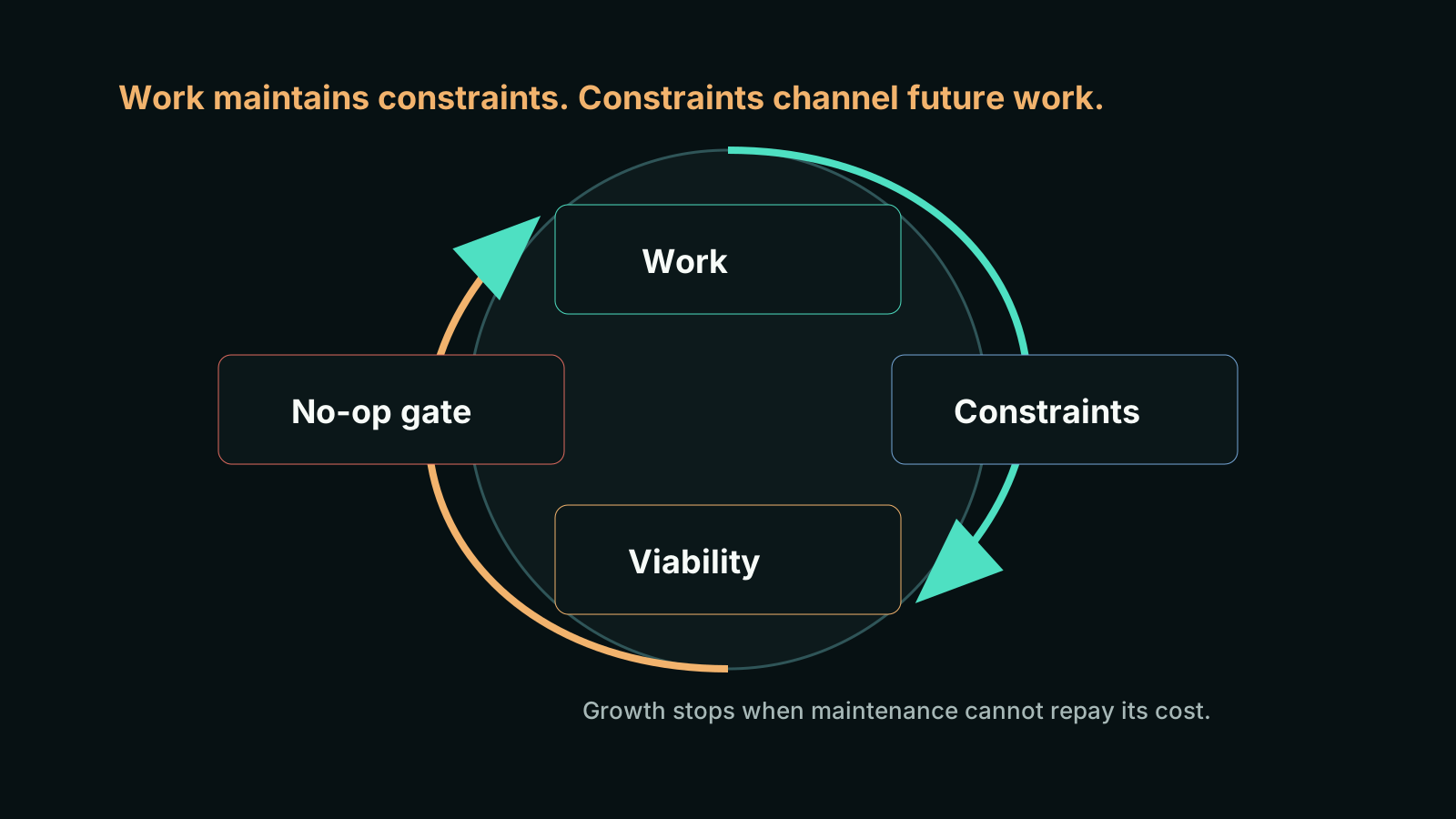
Suggested diagram: a loop where work maintains constraints, constraints channel future work, and R(t) gates whether the loop can expand.
Inference, training, retrieval, and validation cost.
Human interpretation, governance, and explanation burden.
Storage, dependency maintenance, indexes, and trace history.
Ambiguity reduction, fallback pressure, and unresolved cases.
Suppose one glyph cluster repeatedly produces two incompatible meanings. A teleodynamic system proposes a split only if that split reduces confusion enough to repay the cost of maintaining two classes.
No-op is not laziness. It is the system refusing unjustified growth. No-op should win whenever a new structure does not improve viability enough to pay for itself.
No-op is the difference between adaptive intelligence and uncontrolled complexity accumulation.
This guide expands the Theoretical Strategy page into an implementation mental model. It leads naturally into R(t), the operator library, architecture, and evaluation.
Do not say a software system has biological selfhood. Say it operationalizes maintenance, resource accounting, and structural traceability.
Deep route polish
The cycle visual should be read as a reciprocal maintenance pattern, not a claim of intention or life.
The work-constraint cycle is the site’s central design pattern. Work maintains a useful boundary; that boundary then shapes which future work is possible, cheaper, or blocked. No-op dominates when the cycle cannot close.
A trace rule reduces ambiguity only if it also lowers future review burden. If the rule requires constant exceptions, it fails the cycle and should be retired or held back.
| Focus | What to inspect |
|---|---|
| Work | Review, retrieval, scoring, normalization, and trace capture. |
| Constraint | Rules, registries, schemas, and boundaries that channel later work. |
| Closure check | The gain must exceed action cost and maintenance burden. |
The cycle explains a research posture. It does not imply intrinsic purpose, consciousness, or biological status.