
Surface expression only. The visible phrase does not carry exact hidden authority.
Trace inspector
IOTA-1 interpretation walkthroughs
Readable examples show input glyphs, canonical output, bounded glosses, confidence, warnings, and an evidence bridge.
IOTA-1 trace inspector.
Comprehension before confidence: the reader should understand the bridge between visible glyph, canonical output, bounded gloss, warnings, and evidence before trusting a score.
Structured candidate output from a bounded parse.
Approximate explanation for humans; not a certified translation.
Confidence stays below public certainty because warnings remain active.
Warnings reduce claim scope and trigger human review when used in public copy.
The bridge is the reason shown before any confidence statement.
Walkthrough format.
A trustworthy walkthrough shows unresolved parts. It does not hide uncertainty behind a polished English phrase.
- Input expression, direction, segmentation, and candidate concepts.
- Evidence lanes, ontology result, R(t) status, warnings, and bounded gloss.
- Trace summary that a reviewer can inspect.
Boundary statement
These examples are documentation patterns, not claims of exact translation. IOTA-1 outputs are approximate public-symbol interpretations with evidence, warnings, and review status.
Walkthrough 1: expression-concept phrase.
Input
expression concept
Possible output
名意
Bounded gloss
Expression-concept relation, approximate and evidence-dependent.
名 represents visible form, name, or expression. 意 represents meaning, concept, or intended sense. The converter keeps them together to preserve the relation between surface and concept.
Walkthrough 2: AI expression-concept record.
Input
AI expression concept
Possible output
智名意
Warnings
No glyph authority by shape. Requires source provenance. Human comprehension should be tested.
Walkthrough 3: glyph-first parse.
A glyph-first parser can propose a bounded gloss while keeping omitted arguments and uncertain modifiers visible.
{
  "input": "?=汝⟡→=",
  "mode": "glyph-first",
  "canonical": "Question(Becomes(Modified(YOU), UNKNOWN))",
  "bestGloss": "What are you becoming?",
  "confidence": 0.68,
  "warnings": [
    "approximate interpretation",
    "right-side target omitted",
    "state modifier ambiguous"
  ]
}
Walkthrough 4: ɪ≃1 bridge mark.
Input
ɪ≃1
Canonical expression
Approximate(Iota, Unit)
Bounded gloss
"iota approximately one."
The sequence uses visible public elements: an iota-like mark, an approximation relation, and a unit anchor. The system should keep expression and conceptual relation separate.
Evidence workbench.
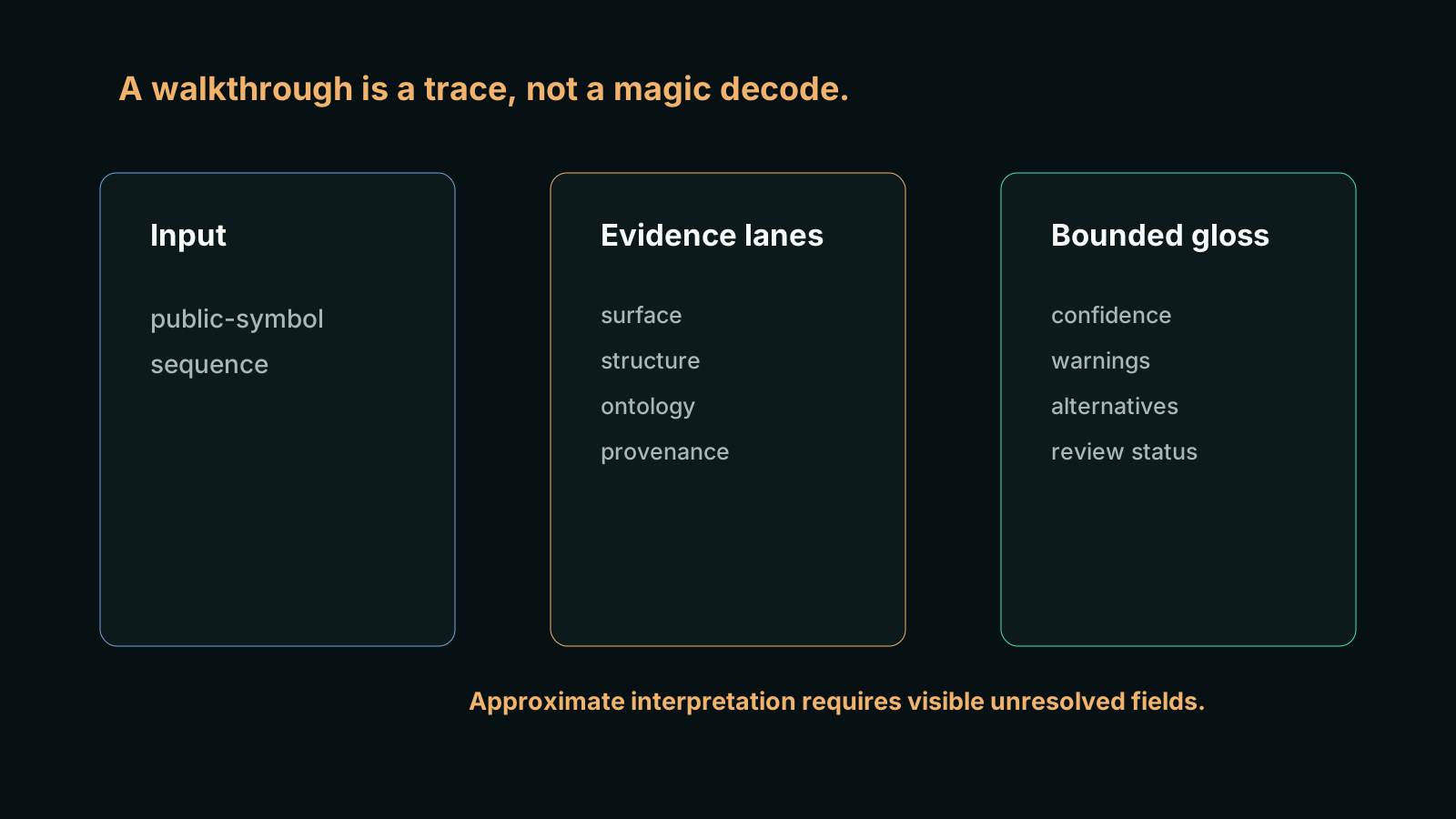
Inputglyph sequence
Rankingsurface, structure, ontology
Glosswarnings and confidence
Suggested diagram: input sequence, segmentation and candidate-ranking lanes, then a bounded gloss with warnings.
How this connects to existing pages.
The walkthroughs bridge Communication, Protocol5 Roadmap, Glyph Object Specification, and Developer Integration. They show how a claim becomes inspectable evidence.
Do not claim.
Do not present examples as canonical language definitions unless they have source provenance and review status. Mark them as approximate and evidence-based.
Deep route polish
Trace-inspector narrative
The walkthrough visual anchors a conservative workflow: input, candidates, warnings, bounded gloss, and evidence bridge before confidence.
Written narrative
IOTA-1 examples are most useful when they show their uncertainty. A walkthrough should make it obvious which part came from visible form, which part came from ontology context, and which part still needs review.
Concrete example
An approximate glyph phrase can produce a candidate canonical form and a bounded gloss, but unresolved targets or ambiguous modifiers must remain visible beside the result.
| Focus | What to inspect |
|---|---|
| Input glyph | The public visible expression being inspected. |
| Canonical output | A structured candidate, not a final authority. |
| Warnings | The reasons confidence must remain bounded. |
Evidence note
Comprehension comes before confidence. A high-looking score is not enough without traceable evidence and warnings.
Internal reading path
/expression-concept-gap/
Expression-Concept Gap in Interpretable AI
Why AI systems must separate visible expression from inferred concept, especially in glyph systems, IOTA-1, and evidence-first semantic conversion.
/unicode-governance/
Unicode Governance for AI and Semantic Glyph Systems
Unicode governance and public-symbol boundaries for AI, semantic glyph systems, ontology-guided interpretation, and IOTA-1 compatibility.
/evaluation-lab/
Evaluation Lab for Interpretable Systems
Metrics, gates, plots, human review worksheets, and audit tests for Teleodynamic AI and semantic glyph interpretation.